<?xml version="1.0" encoding="utf-8"?>
<rss version="2.0" xml:base="http://harvardscience.harvard.edu" xmlns:dc="http://purl.org/dc/elements/1.1/">
<channel>
 <title>All anthropology stories</title>
 <link>http://harvardscience.harvard.edu/topic/3882</link>
 <description></description>
 <language>en</language>
<item>
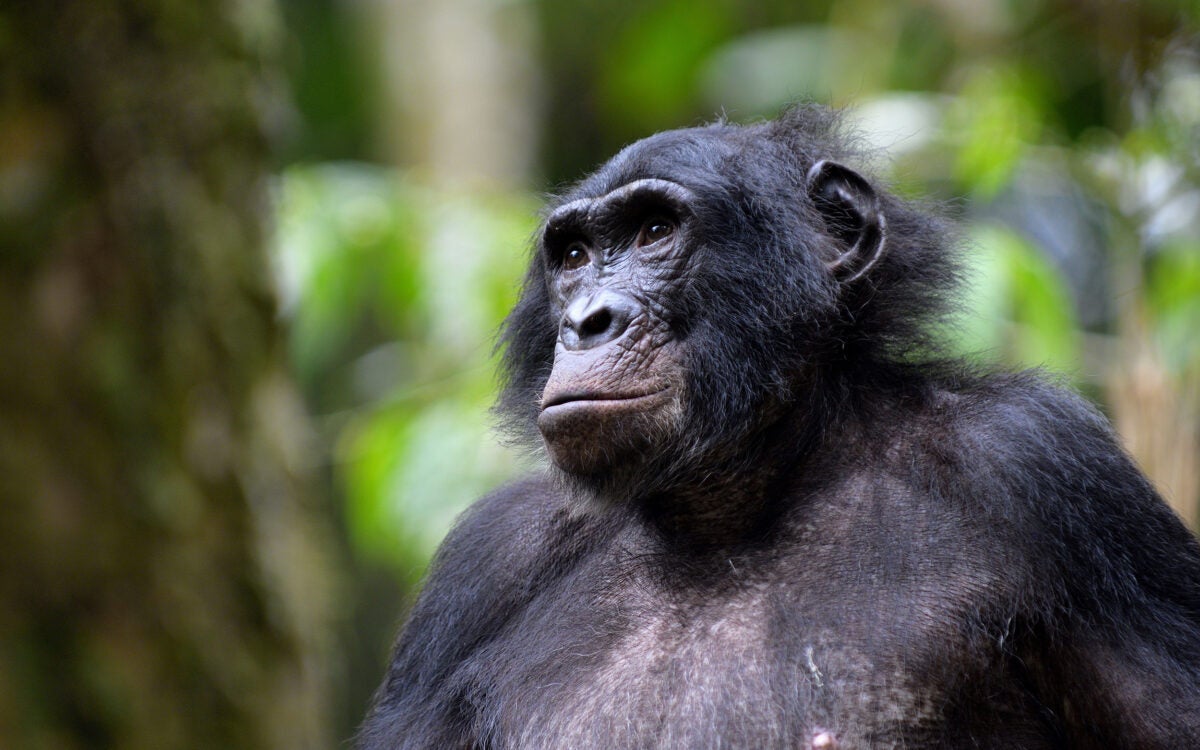
 <title>Chimps in wild appear not to regularly experience menopause</title>
 <link>http://harvardscience.harvard.edu/foundations/articles/chimps-wild-appear-not-regularly-experience-menopause</link>
 <description>&lt;!--paging_filter--&gt;&lt;p&gt;A pioneering study of &lt;a title=&quot;&quot; href=&quot;http://www.wildchimps.org/wcf/english/files/wissen.htm&quot;&gt;wild chimpanzees&lt;/a&gt; has found that these close human relatives do not routinely experience menopause, rebutting previous studies of captive individuals which had postulated that female chimpanzees reach reproductive senescence at 35 to 40 years of age.&lt;br /&gt;&lt;br /&gt;Together with recent data from wild gorillas and orangutans, the finding -- described this week in the journal &lt;a title=&quot;&quot; href=&quot;http://www.current-biology.com/&quot;&gt;Current Biology&lt;/a&gt; -- suggests that human females are rare or even unique among primates in experiencing a lengthy post-reproductive lifespan.&lt;br /&gt;&lt;p&gt;&lt;a href=&quot;http://harvardscience.harvard.edu/foundations/articles/chimps-wild-appear-not-regularly-experience-menopause&quot;&gt;read more&lt;/a&gt;&lt;/p&gt;</description>
 <pubDate>Thu, 13 Dec 2007 11:05:03 -0500</pubDate>
 <dc:creator>404132862</dc:creator>
 <guid isPermaLink="false">20040 at http://harvardscience.harvard.edu</guid>
</item>
<item>
 <title>Redheaded strangers</title>
 <link>http://harvardscience.harvard.edu/foundations/articles/redheaded-strangers</link>
 <description>&lt;!--paging_filter--&gt;&lt;p&gt;Ancient &lt;a title=&quot;&quot; href=&quot;http://www.dnaftb.org/dnaftb/&quot;&gt;DNA&lt;/a&gt; retrieved from the bones of two &lt;a title=&quot;&quot; href=&quot;http://anthropology.si.edu/humanorigins/ha/neand.htm&quot;&gt;Neanderthals&lt;/a&gt; suggests that
at least some of them had red hair and pale skin, scientists report
this week in the journal Science. The international team says that
Neanderthals&#039; &lt;a title=&quot;&quot; href=&quot;http://www.uni-leipzig.de/english/&quot;&gt;pigmentation&lt;/a&gt; may even have been as varied as that of
modern humans, and that at least 1 percent of Neanderthals were likely
redheads.&lt;/p&gt;&lt;p&gt;&lt;a href=&quot;http://harvardscience.harvard.edu/foundations/articles/redheaded-strangers&quot;&gt;read more&lt;/a&gt;&lt;/p&gt;</description>
 <pubDate>Thu, 25 Oct 2007 14:10:48 -0400</pubDate>
 <dc:creator>404132862</dc:creator>
 <guid isPermaLink="false">7636 at http://harvardscience.harvard.edu</guid>
</item>
<item>
 <title>Yale honors E. O. Wilson with Verrill Medal</title>
 <link>http://harvardscience.harvard.edu/animal-vegetable-mineral/articles/yale-honors-e-o-wilson-verrill-medal</link>
 <description>&lt;!--paging_filter--&gt;&lt;p&gt;Yale honors Wilson with Verrill Medal&lt;/p&gt;&lt;p&gt;&amp;nbsp;&amp;nbsp;&amp;nbsp; Pellegrino University Professor Emeritus &lt;a title=&quot;&quot; href=&quot;http://harvardscience.harvard.edu/node/1081&quot;&gt;E.O. Wilson&lt;/a&gt; received the Addison Emery Verrill Medal from Yale’s Peabody Museum of Natural History on Wednesday (Oct. 17) in New Haven, Conn. Awarded by the curators and trustees of the museum, the medal was established in 1959 to honor “some signal practitioner in the arts of natural history and natural science.” Wilson was given the award for his career-spanning efforts to educate the public about the ecological consequences of human behavior. &lt;/p&gt;&lt;p&gt;&lt;a href=&quot;http://harvardscience.harvard.edu/animal-vegetable-mineral/articles/yale-honors-e-o-wilson-verrill-medal&quot;&gt;read more&lt;/a&gt;&lt;/p&gt;</description>
 <pubDate>Wed, 17 Oct 2007 14:58:23 -0400</pubDate>
 <dc:creator>404132862</dc:creator>
 <guid isPermaLink="false">7583 at http://harvardscience.harvard.edu</guid>
</item>
<item>
 <title>Maya, Aztec monument casts get the shake-out, dust-off</title>
 <link>http://harvardscience.harvard.edu/culture-society/articles/maya-aztec-monument-casts-get-shake-out-dust</link>
 <description>&lt;!--paging_filter--&gt;Plaster reproductions of Maya and Aztec carvings, which preserve precious details now lost on the originals, are leaving dusty, haphazard storage for cleaning, cataloging, and crating that will prepare them for a new era of usefulness and relevance. &lt;p&gt; Made more than a century ago, the plaster casts, housed at the Peabody Museum of Archaeology and Ethnology, re-create the elaborate stone carvings that adorned Maya and Aztec cities that once buzzed with life across Central America. &lt;p&gt; The original carvings held images of rulers and rituals as well as examples of script that have proven key to deciphering the Maya’s written language, a process ongoing today.&lt;p&gt;&lt;a href=&quot;http://harvardscience.harvard.edu/culture-society/articles/maya-aztec-monument-casts-get-shake-out-dust&quot;&gt;read more&lt;/a&gt;&lt;/p&gt;</description>
 <pubDate>Mon, 22 Oct 2007 11:29:30 -0400</pubDate>
 <dc:creator>jake</dc:creator>
 <guid isPermaLink="false">7607 at http://harvardscience.harvard.edu</guid>
</item>
<item>
 <title>American Indians bless search for Harvard roots</title>
 <link>http://harvardscience.harvard.edu/culture-society/articles/american-indians-bless-search-harvard-roots</link>
 <description>&lt;!--paging_filter--&gt;With a ceremonial blessing and a cautionary reminder of native peoples’ historic oppression, a group of American Indian leaders joined an assemblage of experienced and budding archaeologists Wednesday (Sept. 26) to begin the search for Harvard’s Indian College roots. &lt;p&gt; Buried somewhere under Harvard Yard’s well-manicured lawn lie the remnants of both the Old College and the Indian College, which more than 350 years ago combined to make up Harvard. &lt;p&gt; For 10 years, beginning in 1655, Harvard’s fourth building and first brick structure housed five students from New England tribes who studied side by side with English students. &lt;p&gt; Only one of those, an Aquinnah Wampanoag named Caleb Cheeshahteamuck, would go on to graduate, becoming Harvard’s first Indian alumnus in 1665.&lt;p&gt;&lt;a href=&quot;http://harvardscience.harvard.edu/culture-society/articles/american-indians-bless-search-harvard-roots&quot;&gt;read more&lt;/a&gt;&lt;/p&gt;</description>
 <pubDate>Mon, 22 Oct 2007 12:40:24 -0400</pubDate>
 <dc:creator>jake</dc:creator>
 <guid isPermaLink="false">7613 at http://harvardscience.harvard.edu</guid>
</item>
<item>
 <title>Farmer, Magaziner: Get involved!</title>
 <link>http://harvardscience.harvard.edu/medicine-health/articles/farmer-magaziner-get-involved</link>
 <description>&lt;!--paging_filter--&gt;&lt;p&gt;Physician and medical anthropologist Paul Farmer and Ira Magaziner, a one-time policy adviser in the Clinton White House, brought humor, counsel, and cautions to a public conversation on student engagement Sept. 20.&lt;/p&gt;&lt;p&gt;Greeting them was a packed-to-the-ceiling John F. Kennedy Jr. Forum, where the crowd was noisy, young, and ready to laugh — egged on by Farmer’s explosive wit. Magaziner, measured and lugubrious, happily played the young doctor’s straight man.&lt;/p&gt;&lt;p&gt;Not that the panel was a laughing matter. With audience questions included, it was a 90-minute look at global health challenges and related avenues for student activism.&lt;/p&gt;&lt;p&gt;&lt;a href=&quot;http://harvardscience.harvard.edu/medicine-health/articles/farmer-magaziner-get-involved&quot;&gt;read more&lt;/a&gt;&lt;/p&gt;</description>
 <pubDate>Mon, 01 Oct 2007 13:25:36 -0400</pubDate>
 <dc:creator>50443248</dc:creator>
 <guid isPermaLink="false">7457 at http://harvardscience.harvard.edu</guid>
</item>
<item>
 <title>Male voice pitch predicts reproductive success in hunter-gatherers</title>
 <link>http://harvardscience.harvard.edu/culture-society/articles/male-voice-pitch-predicts-reproductive-success-hunter-gatherers</link>
 <description>&lt;!--paging_filter--&gt;&lt;p&gt;Deeper voice pitch predicts reproductive success in male hunter-gatherers, according to a new study from researchers with Harvard University, McMaster University, and Florida State University.&lt;/p&gt;&lt;p&gt;This is the first study to examine the correlation between voice pitch and child-bearing success, and the results point to a role for voice pitch in Darwinian fitness in humans.&lt;/p&gt;&lt;p&gt;The study, published online this week in the journal Biology Letters, was led by Coren Apicella, a doctoral candidate in the Department of Anthropology in the Faculty of Arts and Sciences (FAS) at Harvard University, with David Feinberg of McMaster University and Frank Marlowe of Florida State University.&lt;/p&gt;&lt;p&gt;&lt;a href=&quot;http://harvardscience.harvard.edu/culture-society/articles/male-voice-pitch-predicts-reproductive-success-hunter-gatherers&quot;&gt;read more&lt;/a&gt;&lt;/p&gt;</description>
 <pubDate>Mon, 01 Oct 2007 12:17:39 -0400</pubDate>
 <dc:creator>50443248</dc:creator>
 <guid isPermaLink="false">7454 at http://harvardscience.harvard.edu</guid>
</item>
<item>
 <title>Archaeological bookends in Copan Valley</title>
 <link>http://harvardscience.harvard.edu/culture-society/articles/archaeological-bookends-copan-valley</link>
 <description>&lt;!--paging_filter--&gt;&lt;p&gt; COPAN RUINAS, Honduras - A short drive from the main Maya ruins at Copan, a forested hillside holds a cluster of mounds that Peabody Museum archaeologists believe date from near the end of the great Maya civilization that once dominated the region.&lt;/p&gt;
&lt;p&gt;On April 17, 2007, Peabody Museum director and Bowditch Professor of Central American and Mexican Archaeology and Ethnology William Fash, along with director of the Corpus of Maya Hieroglyphic Inscriptions Program Barbara Fash and two Harvard graduate students, walked the site with Honduran government officials charged with regulating and overseeing archaeological activity in the Central American nation.&lt;/p&gt;
&lt;p&gt;&lt;a href=&quot;http://harvardscience.harvard.edu/culture-society/articles/archaeological-bookends-copan-valley&quot;&gt;read more&lt;/a&gt;&lt;/p&gt;</description>
 <pubDate>Mon, 23 Apr 2007 13:15:07 -0400</pubDate>
 <dc:creator>90581724</dc:creator>
 <guid isPermaLink="false">4247 at http://harvardscience.harvard.edu</guid>
</item>
<item>
 <title>Seeing the forest, from the trees</title>
 <link>http://harvardscience.harvard.edu/animal-vegetable-mineral/articles/seeing-forest-trees</link>
 <description>&lt;!--paging_filter--&gt;&lt;p&gt;It was Valentine’s Day 2000 and Alain Houle was not quite sure what to do. He was alone in a fruit tree and the chimps were coming back.&lt;/p&gt;&lt;p&gt;“I thought I’d be killed,” Houle said later. “They climbed up, looked at me, barked at me, and then settled down to eat.”&lt;/p&gt;&lt;p&gt;After Houle climbed down that day, he returned to the research station in Uganda’s Kibale National Park and met Richard Wrangham, Ruth Moore Professor of Biological Anthropology, who has studied the park’s chimpanzees since 1987.&lt;/p&gt;&lt;p&gt;Though Houle was in the park studying the diets of monkeys for his doctoral work at the University of Quebec at Montreal, Wrangham expressed interest in Houle’s experience and said that chimpanzees had never been studied at eye-level in the treetops before.&lt;/p&gt;</description>
 <pubDate>Wed, 03 Oct 2007 09:17:48 -0400</pubDate>
 <dc:creator>50443248</dc:creator>
 <guid isPermaLink="false">7521 at http://harvardscience.harvard.edu</guid>
</item>
<item>
 <title>Orangutan research yields conservation dividends</title>
 <link>http://harvardscience.harvard.edu/animal-vegetable-mineral/articles/orangutan-research-yields-conservation-dividends</link>
 <description>&lt;!--paging_filter--&gt;&lt;p&gt;Cheryl Knott remembers the first time she heard the sound of chainsaws shattering the quiet in Indonesia&#039;s Gunung Palung National Park.&lt;/p&gt;&lt;p&gt;It was the late 1990s and Knott, an associate professor of anthropology who studies orangutan biology in the park&#039;s rain forest, said researchers at the Cabang Panti Research Station listened as the ominous sound grew ever nearer.&lt;/p&gt;&lt;p&gt;&quot;There were illegal loggers in the National Park, thousands of loggers,&quot; Knott said. &quot;Every morning, you could hear the sound of chainsaws, and knew they were getting closer.&quot;&lt;/p&gt;&lt;p&gt;&lt;a href=&quot;http://harvardscience.harvard.edu/animal-vegetable-mineral/articles/orangutan-research-yields-conservation-dividends&quot;&gt;read more&lt;/a&gt;&lt;/p&gt;</description>
 <pubDate>Wed, 03 Oct 2007 11:06:40 -0400</pubDate>
 <dc:creator>50443248</dc:creator>
 <guid isPermaLink="false">7530 at http://harvardscience.harvard.edu</guid>
</item>
<item>
 <title>Figs likely first domesticated crop</title>
 <link>http://harvardscience.harvard.edu/culture-society/articles/figs-likely-first-domesticated-crop</link>
 <description>&lt;!--paging_filter--&gt;&lt;p&gt;Archaeobotanists have found evidence that the dawn of agriculture may have come with the domestication of fig trees in the Near East some 11,400 years ago, roughly 1,000 years before such staples as wheat, barley, and legumes were domesticated in the region. The discovery dates domesticated figs to a period some 5,000 years earlier than previously thought, making the fruit trees the oldest known domesticated crop.&lt;/p&gt;
&lt;p&gt;Ofer Bar-Yosef of Harvard University and Mordechai E. Kislev and Anat Hartmann of Bar-Ilan University report their findings in this week&#039;s issue of the journal Science.&lt;/p&gt;
&lt;p&gt;&lt;a href=&quot;http://harvardscience.harvard.edu/culture-society/articles/figs-likely-first-domesticated-crop&quot;&gt;read more&lt;/a&gt;&lt;/p&gt;</description>
 <pubDate>Fri, 13 Jul 2007 10:14:57 -0400</pubDate>
 <dc:creator />
 <guid isPermaLink="false">4400 at http://harvardscience.harvard.edu</guid>
</item>
<item>
 <title>Wakeley examines ancestral lines</title>
 <link>http://harvardscience.harvard.edu/culture-society/articles/wakeley-examines-ancestral-lines</link>
 <description>&lt;!--paging_filter--&gt;&lt;p&gt;John Wakeley is devising new ways to trace the evolutionary road  taken by humans and the creatures with whom we share planet  Earth by creating new models that examine how DNA has  changed over time.
&lt;p&gt;A theoretical population geneticist, Wakeley&#039;s research focuses  on how our DNA changes as it is passed from generation to  generation. He is examining how the tendency of humans to live  in groups separated by ethnicity or by physical barriers like  mountains and rivers affects DNA&#039;s random changes.
&lt;p&gt;Understanding groupings of individuals can be critical to  figuring out why our DNA carries particular patterns today.  That&#039;s because changes in patterns of genetic variation due to  genetic drift - one of the major forces behind evolution - occur  more rapidly in smaller populations and subpopulations.&lt;/p&gt;
</description>
 <pubDate>Mon, 26 Mar 2007 06:26:51 -0400</pubDate>
 <dc:creator>70652986</dc:creator>
 <guid isPermaLink="false">3804 at http://harvardscience.harvard.edu</guid>
</item>
<item>
 <title>Blogging from the Ugandan forest</title>
 <link>http://harvardscience.harvard.edu/environments/articles/blogging-ugandan-forest</link>
 <description>&lt;!--paging_filter--&gt;&lt;p&gt;A Web log, or blog, co-written by Harvard researcher Ian Gilby,  working in Uganda&#039;s Kibale Forest, makes vivid the family lives  of chimpanzees. The blog, on the Anthropology Department  Web site, also provides an unusual glimpse into the daily life of a  field scientist.
&lt;p&gt;The blog was the brainchild of Alex Georgiev, a graduate  student in anthropology who was working with Gilby last fall to  update the Kibale Chimpanzee Project&#039;s Web site. Georgiev  argued that the Web site ought to have changing features that  bring people back again. The blog was one way to do that, Gilby  said.
&lt;p&gt;In addition to drawing people to the Web site, however, Gilby  said the blog is a new way for scientists to communicate to the  public.&lt;/p&gt;
&lt;p&gt;&lt;a href=&quot;http://harvardscience.harvard.edu/environments/articles/blogging-ugandan-forest&quot;&gt;read more&lt;/a&gt;&lt;/p&gt;</description>
 <pubDate>Mon, 26 Mar 2007 06:25:50 -0400</pubDate>
 <dc:creator>70652986</dc:creator>
 <guid isPermaLink="false">3779 at http://harvardscience.harvard.edu</guid>
</item>
<item>
 <title>Ancient humans brought bottle gourds to Americas from Asia</title>
 <link>http://harvardscience.harvard.edu/culture-society/articles/ancient-humans-brought-bottle-gourds-americas-asia</link>
 <description>&lt;!--paging_filter--&gt;&lt;p&gt;Thick-skinned bottle gourds widely used as containers by  prehistoric peoples were likely brought to the Americas some  10,000 years ago by individuals who arrived from Asia,  according to a new genetic comparison of modern bottle gourds  with gourds found at archaeological sites in the Western  Hemisphere. The finding solves a longstanding archaeological  enigma by explaining how a domesticated variant of a species  native to Africa ended up millennia ago in places as far removed  as modern-day Florida, Kentucky, Mexico, and Peru.
&lt;p&gt;The work, by a team of anthropologists and biologists from  Harvard University, the Smithsonian Institution&#039;s National  Museum of Natural History, Massey University in New Zealand,  and the University of Maine, appeared on the Web site of the  Proceedings of the National Academy of Sciences (PNAS).
&lt;p&gt;Integrating genetics and archaeology, the researchers assembled  a collection of ancient remnants of bottle gourds from across  the Americas. They then identified key genetic markers from the  DNA of both the ancient gourds and their modern counterparts  in Asia and Africa before comparing the plants&#039; genetic makeup  to determine the origins of the New World gourds.
&lt;p&gt;&quot;For 150 years, the dominant theory has been that bottle  gourds, which are quite buoyant and have no known wild  progenitors in the Americas, floated across the Atlantic Ocean  from Africa and were picked up and used as containers by  people here,&quot; says Noreen Tuross, the Landon T. Clay Professor  of Scientific Archaeology in Harvard&#039;s Faculty of Arts and  Sciences. &quot;Much to our surprise, we found that in every case the  gourds found in the Americas were a genetic match with modern  gourds found in Asia, not Africa. This suggests quite strongly  that the gourds that were used as containers in the Americas for  thousands of years before the advent of pottery were brought  over from Asia.&quot;
&lt;p&gt;The work was supported by the Smithsonian Institution and the  National Museum of Natural History and by Harvard&#039;s  Department of Anthropology and Peabody Museum of  Archaeology and Ethnology.&lt;/p&gt;
</description>
 <pubDate>Mon, 26 Mar 2007 05:43:07 -0400</pubDate>
 <dc:creator>70652986</dc:creator>
 <guid isPermaLink="false">3583 at http://harvardscience.harvard.edu</guid>
</item>
<item>
 <title>Chinese salt evidence spared from flood</title>
 <link>http://harvardscience.harvard.edu/culture-society/articles/chinese-salt-evidence-spared-flood</link>
 <description>&lt;!--paging_filter--&gt;&lt;p&gt;American and Chinese researchers digging at an imperiled site of ancient salt production found the earliest known evidence of salt manufacturing in China.&lt;br /&gt;
Salt manufacturing is regarded as an important step in the development of complex societies because its trade not only spurred economic activity, it also encouraged communication along trade routes, prompted ethnic diversification in cooking, and opened new regions to settlement.&lt;/p&gt;
&lt;p&gt;Archaeologists found evidence of large-scale salt production dating to the first millennium B.C. at a site called Zhongba, on the Yangtze River northeast of Chongquing. The site, upstream of the enormous Three Gorges Dam project, flooded in 2004 after excavation was complete and is now under the waters of the dam&#039;s manmade lake.&lt;/p&gt;
&lt;p&gt;&lt;a href=&quot;http://harvardscience.harvard.edu/culture-society/articles/chinese-salt-evidence-spared-flood&quot;&gt;read more&lt;/a&gt;&lt;/p&gt;</description>
 <pubDate>Fri, 20 Jul 2007 14:37:45 -0400</pubDate>
 <dc:creator>50443248</dc:creator>
 <guid isPermaLink="false">4518 at http://harvardscience.harvard.edu</guid>
</item>
</channel>
</rss>